Knot Tying for Campers: 5 Essential Knots to Master
Unlock Your Outdoor Potential: The Essential Skill of Knot Tying
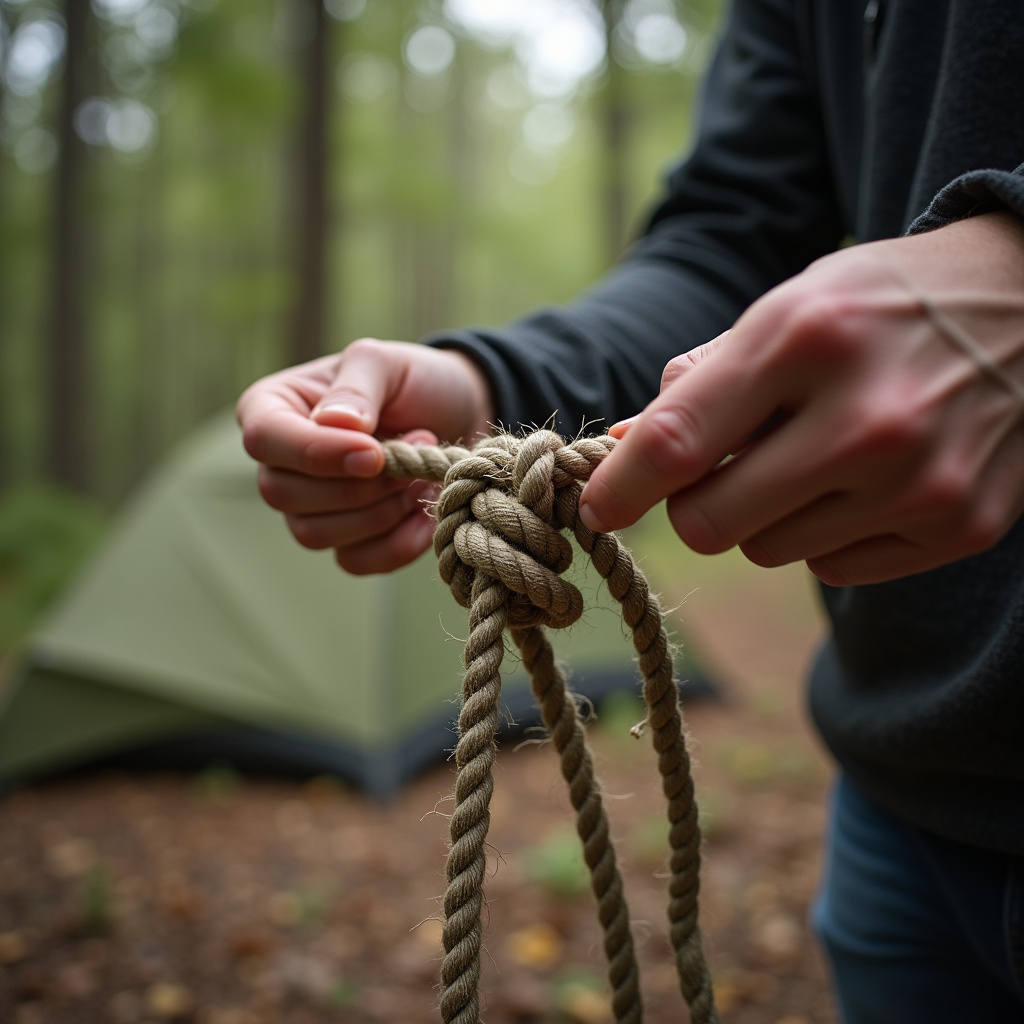
Welcome, fellow outdoor enthusiasts, to WildGridScout! Today, we’re diving deep into a skill that is as ancient as it is essential for anyone venturing into the wilderness: knot tying. Far from being a mere scout badge requirement, mastering a few key knots can elevate your camping experience from fumbling frustration to confident competence. From securing your shelter against a sudden gust of wind to safely hanging your food away from curious critters, knots are the unsung heroes of outdoor living.
In the vast expanse of knot knowledge, there are hundreds, if not thousands, of specific ties. But fear not! You don’t need to become a master mariner overnight. For the average camper, hiker, or backpacker, focusing on a select handful of versatile knots will cover 90% of your needs. These are the workhorses – reliable, easy to tie (with practice), and indispensable. We’re going to break down five such essential knots that every outdoor adventurer should have in their repertoire. Let’s get started!
1. The Bowline: The King of Loops
Often referred to as the “King of Knots,” the Bowline creates a fixed, non-slipping loop at the end of a rope. What makes it so valuable is its reliability under load – it won’t slip or tighten, yet it’s relatively easy to untie even after being subjected to significant tension. This makes it a crucial knot for safety-critical applications.
- Why it’s essential:
- Bear Bags: The ultimate knot for hoisting a bear bag over a branch, keeping your food safe from wildlife. The fixed loop makes it easy to tie off to another rope or carabiner.
- Rescue & Safety: In emergency situations, a Bowline can be quickly tied around a person for rescue, providing a secure handhold or harness.
- Mooring: Securing a canoe, kayak, or small boat to a dock or tree.
- How to tie: While a step-by-step visual is best for learning, the classic mnemonic “The rabbit comes out of the hole, goes around the tree, and back down the hole” offers a conceptual guide. Practice until it becomes muscle memory. Resources like the Animated Knots by Grog are excellent for visual learners.
2. The Clove Hitch: Quick & Temporary Security
The Clove Hitch is a versatile knot for temporarily securing a rope to a pole, post, or tree. Its strength lies in its simplicity and speed, making it perfect for quick setups or when you need to attach a rope without a free end. However, it’s important to note that the Clove Hitch can slip if not under constant tension or if the object it’s tied around is too smooth. For critical applications, a half hitch or two might be added for extra security.
- Why it’s essential:
- Clotheslines: A quick and easy way to string up a clothesline at your campsite.
- Securing Gear: Temporarily attaching items to your backpack or raft.
- Starting Lashings: Often used as a foundational knot to begin more complex lashing patterns for building structures.
- How to tie: There are several methods, but the easiest involves creating two loops (one clockwise, one counter-clockwise) and placing them on top of each other before slipping them over the end of a pole.
3. The Taut-line Hitch: The Adjustable Workhorse
If there’s one knot that will transform your tent pitching and tarp setup, it’s the Taut-line Hitch. This ingenious knot creates an adjustable loop along a rope under tension. It allows you to tighten or loosen a line quickly and securely, making it invaluable for adapting to changing conditions or simply getting your setup just right.
- Why it’s essential:
- Tent & Tarp Guy Lines: The primary use for this knot, allowing you to easily adjust the tension of your shelter’s guy lines to keep it taut and stable.
- Securing Loads: Excellent for cinching down gear on a pack or roof rack, offering adjustable pressure.
- Emergency Repairs: Can be used to create tension in a jury-rigged shelter or brace.
- How to tie: Typically, two turns are made around the standing part of the rope, moving away from the anchor, followed by a third half hitch in the opposite direction. This creates a friction hitch that slides when adjusted but holds firmly under tension.
4. The Square Knot (Reef Knot): The Simple Joiner (with a caveat)
The Square Knot is one of the most basic and widely known knots for joining two ropes of similar size. It’s simple to learn and quick to tie, making it useful in many non-critical situations. However, and this is a crucial caveat, the Square Knot is notoriously unreliable under sustained or heavy loads, especially if the ropes are of different sizes or materials. It can slip and untie itself, and should NEVER be used for anything where human safety is at stake.
- Why it’s essential (with caution):
- Bundling: Tying together items for storage or transport.
- First Aid: Securing a bandage or sling (though a surgeon’s knot is often preferred).
- Non-Critical Applications: Anytime you need to join two ropes temporarily where failure wouldn’t be dangerous.
- How to tie: “Right over left, then left over right.” It’s a simple crossing and tucking motion, resulting in a flat knot. Always double-check its security, especially if using it for anything that will bear even a moderate load.
5. The Figure-Eight Knot: The Reliable Stopper
The Figure-Eight knot is perhaps the most fundamental and reliable stopper knot. Its primary purpose is to create a bulk at the end of a rope, preventing it from slipping through a hole, pulley, or carabiner. Unlike the simpler overhand knot, the Figure-Eight is less prone to jamming and is much easier to untie after being under load, making it a safer and more practical choice for a stopper.
- Why it’s essential:
- Preventing Slippage: Keeping the end of a rope from running out of a belay device, pulley, or grommet.
- Creating a Handle: Tying it into a loop to create a secure, non-slip handhold.
- Foundation for Other Knots: Many more complex knots begin with a variation of the Figure-Eight.
- How to tie: Form a loop, then pass the working end over the standing part and through the loop, forming a distinctive “8” shape.
Practice Makes Perfect: Your Knots, Your Safety
Learning these five knots is just the beginning. The real mastery comes with practice. Grab a piece of rope – even a shoelace will do – and tie each knot repeatedly until you can do it blindfolded, quickly, and under pressure. Understand not just *how* to tie them, but *when* to use each one, and critically, their limitations. The more comfortable you are with these foundational knots, the more confident and capable you’ll become in any outdoor situation.
Remember, a well-tied knot is a testament to preparedness and respect for the wild. It’s a small skill with enormous practical implications for safety, efficiency, and enjoyment in your outdoor pursuits. So, get tying, adventurers, and let your journey be securely bound!
Sources & Further Reading:
- Ashley, Clifford W. The Ashley Book of Knots. Doubleday, 1944. (A comprehensive historical and practical guide to knots.)
- Gibbs, Steven and J. M. Gibson. The Illustrated Encyclopedia of Knots. Quantum Publishing, 2007. (A great visual resource for learning various knots.)
- General outdoor skills guides from organizations like the Boy Scouts of America, REI, and Leave No Trace Center for Outdoor Ethics. (These resources often cover practical camping and safety knots.)