Animal Tracks Identification: A Beginner’s Guide
The wilderness holds countless secrets, whispers of life that often go unnoticed by the hurried eye. But for those who slow down, who learn to read the subtle signs etched into the earth, a whole new world of understanding opens up. Animal track identification is more than just a survival skill; it’s a deep dive into the hidden lives of the creatures sharing our wild spaces, a fascinating journey that connects us intimately with the pulse of nature. At WildGridScout, we believe in empowering every outdoor enthusiast with practical skills, and few are as rewarding as learning to decipher the silent stories left behind by paws, hooves, and claws.
Why Learn to Read the Wild Grid?
Imagine hiking a serene trail, and suddenly, you spot a distinct print in the soft mud. Is it a dog? A coyote? Perhaps a bobcat? Knowing how to identify these tracks transforms a simple walk into an investigative adventure. It allows you to:
- Understand Wildlife Behavior: Tracks reveal where an animal has been, what it was doing (hunting, foraging, fleeing), and even its pace and direction.
- Enhance Your Safety: Identifying tracks of potentially dangerous animals (like bears or cougars) can inform your decisions and help you avoid encounters.
- Deepen Your Connection to Nature: There’s an undeniable thrill in recognizing the presence of an elusive creature, feeling a closer bond to the ecosystem around you.
- Track for Photography or Observation: For wildlife enthusiasts and photographers, tracks are invaluable clues leading to potential sightings.
The Fundamentals: What to Look For
Reading tracks is akin to detective work. You’re looking for patterns, specific features, and context clues. Here are the fundamental elements to consider:
1. Overall Shape and Size
Is it round, elongated, heart-shaped? How big is it compared to your hand or a common object? This immediately helps narrow down possibilities (e.g., a small rodent vs. a large deer).
2. Number of Toes
This is a crucial differentiator. Most mammals have five toes, but not all five are always visible in a print. Canines typically show four toes on both front and hind feet. Felines also show four toes. Deer and other ungulates (hoofed animals) show two prominent hooves, often with two smaller “dewclaws” that may or may not register in the print, especially in soft substrates.
3. Claw Marks
Are claws visible? This is one of the most reliable ways to distinguish between canines and felines.
- Canines (dogs, coyotes, foxes): Usually show distinct claw marks ahead of each toe pad. Their claws are generally non-retractable.
- Felines (bobcats, cougars): Typically do NOT show claw marks, as their claws are retractable and usually sheathed when walking.
4. Heel Pad Shape and Position
The main pad behind the toes, often called the plantar pad, has a distinct shape for many animals.
- Canines: Often have a roughly triangular or trapezoidal heel pad with a single lobe at the back.
- Felines: Typically have a distinctive M-shaped or three-lobed heel pad.
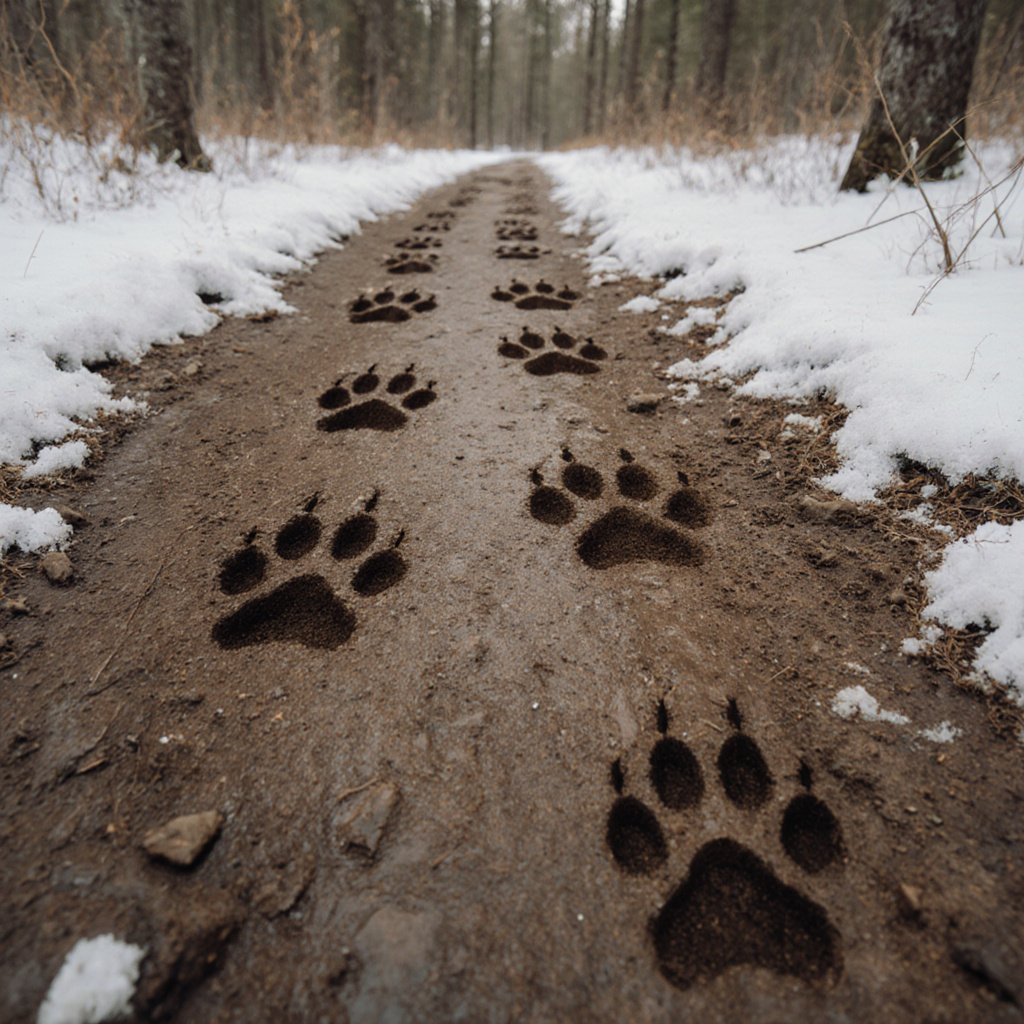
- Bears: Possess a large, broad heel pad that registers a nearly full footprint, indicating their plantigrade (flat-footed) walk.
5. Symmetry
Draw an imaginary line down the center of the track.
- Canine tracks: Often appear more symmetrical, with an almost ‘X’ shape in the negative space between the toes and heel pad.
- Feline tracks: Tend to be asymmetrical due to their slightly rotated inner toe.
6. Gait and Stride
How an animal moves leaves a specific pattern of tracks. This “gait” can tell you about its speed, intent, and even its species.
- Direct Register: When a hind foot lands directly in the print of the corresponding front foot (common in many predators like foxes and deer).
- Walk/Trot: Alternating left and right tracks, often with some overlap.
- Bound: All four feet land close together, often with front feet staggered, followed by hind feet together (common in weasels, martens).
- Gallop: All four feet lift off the ground, then land. Often a distinct pattern of front feet landing first, followed by hind feet landing ahead of or beside the front prints (rabbits, hares, deer when fleeing).
Look at the distance between prints (stride length) and the overall pattern of the trail.
7. Substrate
The material the track is made in (mud, snow, sand, dust) greatly affects its clarity and appearance. A track in firm mud will look different from the same track in deep, powdery snow. Always consider how the substrate might distort the print.
Common Tracks to Know
Canines (Dogs, Coyotes, Foxes)
Typically four toes on front and hind feet. Claws almost always visible. Pads are generally more compact, and the overall print is often somewhat symmetrical. The heel pad is triangular or trapezoidal. A good rule of thumb: you can often draw an ‘X’ in the negative space between the toes and heel pad. Domestic dog tracks vary widely, but wild canines like coyotes and foxes will have more elliptical, narrower prints.
Source: Halfpenny, J. C. (1999). A Field Guide to Animal Tracks and Signs of North America. Stackpole Books.
Felines (Bobcats, Mountain Lions/Cougars)
Four toes on front and hind feet. No visible claw marks (claws are retractable). The heel pad is distinctively M-shaped or three-lobed. Feline tracks are generally rounder and more asymmetrical than canine tracks. If you can draw an ‘X’ in the negative space, it’s likely a canine; if not, it could be a feline.
Source: Elbroch, M., & Evans, C. (2018). Animal Tracks and Scat of California. Falcon Guides.
Deer (White-tailed Deer, Mule Deer, Elk)
Two distinct, cloven hooves, making a heart-shaped print. The two halves of the hoof will often spread slightly when the animal is moving or on soft ground. Dewclaws (two smaller toes higher up on the leg) may show in deep snow or mud, appearing as small dots behind the main hooves. Deer tracks are generally pointed at the front and rounded at the back.
Source: Stokes, D. W., & Stokes, L. (1986). A Guide to Animal Tracking and Behavior. Little, Brown and Company.
Raccoons
Known for their distinctive “hand-like” front paws with five long, slender, finger-like toes, and “foot-like” hind paws, also with five toes, which are longer and more splayed, resembling a miniature human foot. Claw marks are usually visible. Their gait often involves the hind foot landing just behind the front foot, creating a staggered walking pattern.
Bears (Black Bear, Grizzly Bear)
Large, distinctive tracks. Five toes are visible, often with clear claw marks (especially the front paw’s inner toe, which is usually shorter and more blunt). Bears are plantigrade, meaning they walk on the soles of their feet, leaving a broad heel pad print much like a human. Hind footprints are typically larger and more elongated than front prints. Look for a distinctly “pigeon-toed” appearance in the front paws, with the inner toes pointing slightly inward.
Source: Brown, C. K. (2019). Tracking & The Art of Seeing: How to Read Animal Tracks and Sign. Stackpole Books.
Tips for the Budding Tracker
- Carry a Field Guide: A good animal tracking guide specific to your region is an invaluable tool.
- Measure and Photograph: Always carry a ruler or tape measure and a camera. Place the ruler next to the track for scale when photographing.
- Practice, Practice, Practice: The more you look, the better you’ll become. Start in areas with abundant wildlife.
- Look for Associated Signs: Tracks are just one piece of the puzzle. Look for scat (droppings), browse marks (gnawed plants), rubs (where animals have rubbed against trees), or hair.
- Be Patient and Observant: Take your time. Don’t just look down; observe the surrounding environment for other clues.
- Respect Wildlife and Leave No Trace: Observe from a distance. Do not disturb animals or their habitat. Leave tracks as you found them for others to discover.
Embark on Your Tracking Journey
Learning animal track identification is a journey, not a destination. Each new print tells a unique story, offering a glimpse into the wild heart of our planet. So next time you’re out on the trail, slow down, look down, and listen. The wilderness is speaking, and with a little practice, you’ll soon understand its ancient language. Happy tracking!