Stargazing for Campers: A Beginner’s Guide to the Night Sky
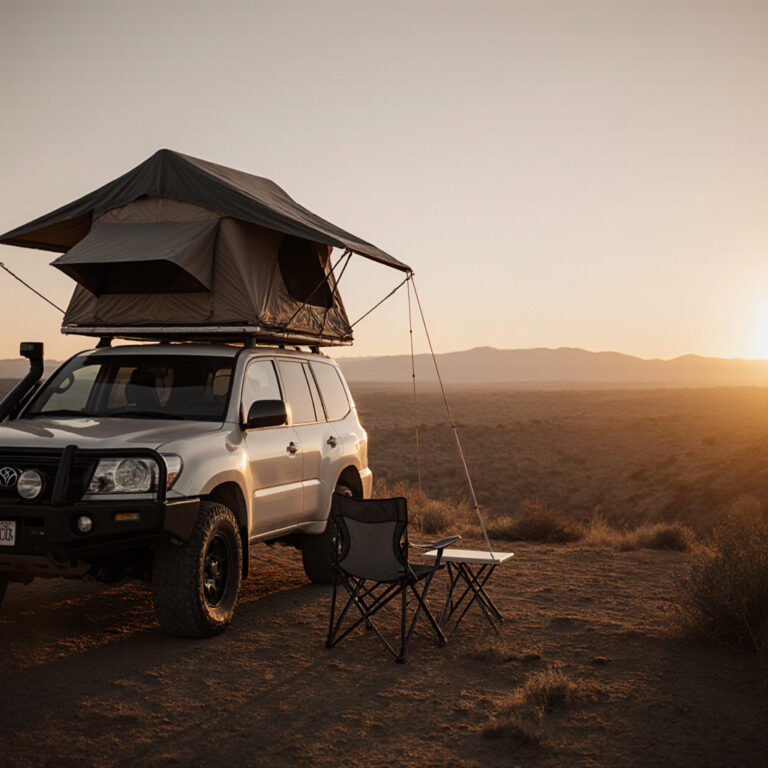
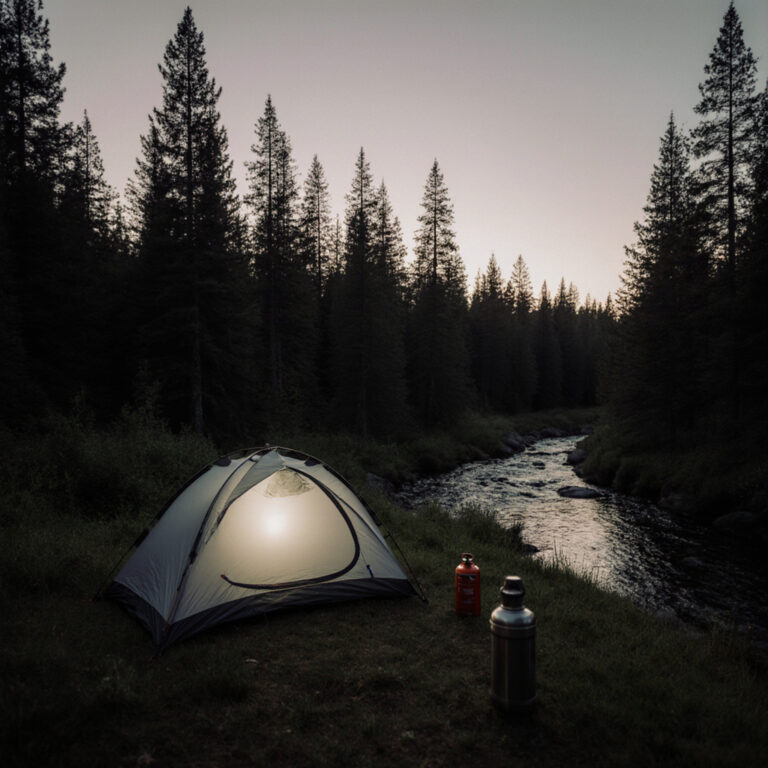
There’s a certain magic that washes over you when the sun dips below the horizon in the wilderness, painting the sky with fiery hues before giving way to the inky blackness. But the real show often begins when the last vestiges of twilight fade, and the heavens ignite with a breathtaking tapestry of stars. For campers, this isn’t just a bonus; it’s an inherent part of the experience, a profound connection to something ancient and vast. Far from the oppressive glare of city lights, the wilderness offers an unparalleled observatory, a front-row seat to the cosmic ballet that unfolds every night. This guide is your first step into unlocking the secrets of the night sky, transforming your camping trips into unforgettable stargazing adventures.
Why Campers Make the Best Stargazers:
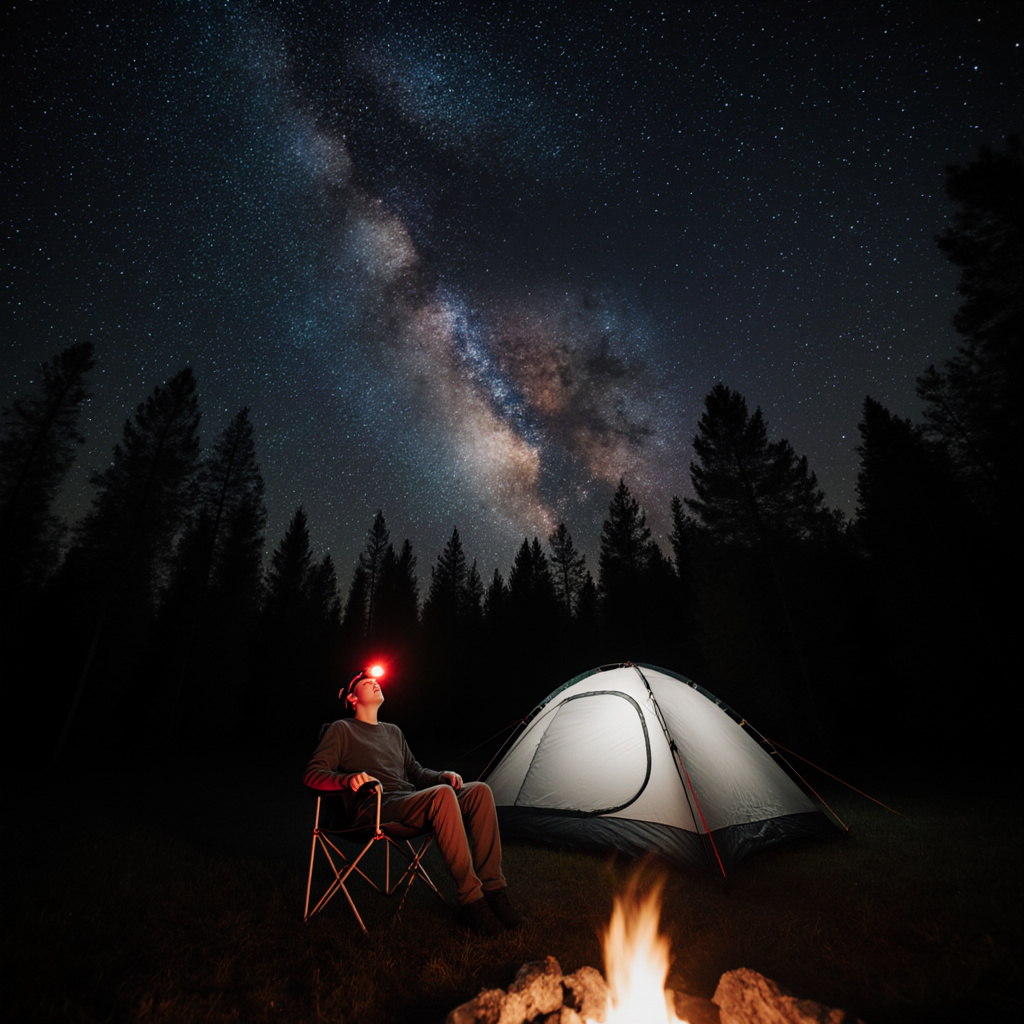
The primary advantage campers have over urban dwellers when it comes to stargazing is simple: darkness. Light pollution, the excessive and misdirected use of artificial outdoor lighting, obscures our view of the stars, washing out all but the brightest celestial objects. According to the International Dark-Sky Association (IDA), over 80% of the world’s population lives under light-polluted skies, with a third of humanity unable to see the Milky Way. Camping in remote areas, national parks, and designated dark sky preserves offers an escape from this light “smog,” revealing the universe in its full, glorious detail. Imagine seeing the Milky Way stretch across the sky like a celestial river – an experience many city residents have never had.
The Minimalist Stargazer’s Kit:
One of the beauties of stargazing is how little gear you truly need. Our ethos at WildGridScout is always about practical, minimalist approaches, and stargazing fits perfectly. Here’s what you’ll want to pack:
- Red-Light Headlamp: This is crucial. White light destroys your night vision, which takes about 20-30 minutes to fully adapt to the dark. A headlamp with a red-light setting allows you to see your immediate surroundings without compromising your eyes’ dark adaptation.
- Comfortable Seating: A lightweight camping chair or a simple foam pad for lying on the ground will make hours of neck-craning much more enjoyable.
- Binoculars (Optional but Recommended): While not strictly essential for beginners, a good pair of binoculars (7×50 or 10×50 are popular choices) can dramatically enhance your experience. They’re excellent for observing the Moon’s craters, spotting Jupiter’s moons, or resolving star clusters.
- Star Chart or App: A physical star chart (red-light compatible) or a stargazing app on your smartphone (with a red-light filter setting) will help you identify constellations and planets. More on this below!
- Warm Layers: Even on a warm day, nights in the wilderness can get surprisingly chilly. Pack extra layers, a hat, and gloves to stay comfortable.
- Hot Drink and Snacks: A thermos of hot tea or chocolate and some energy bars can make a long night under the stars even more pleasant.
Finding Your Cosmic Canvas: Locating Dark Skies:
To truly appreciate the night sky, you need to get away from light pollution. Here’s how to find the best spots:
- International Dark-Sky Association (IDA): The IDA certifies “International Dark Sky Places” – parks, reserves, and communities committed to preserving dark skies. Check their website for a list near your camping destination.
- Light Pollution Maps: Websites like LightPollutionMap.info allow you to visualize light pollution globally, helping you pinpoint truly dark locations.
- National Parks and Forests: Generally, these vast, protected areas offer excellent dark skies, especially away from visitor centers or major roads. Always check local regulations regarding night use.
Your First Steps into the Cosmos: Naked Eye Stargazing:
Before reaching for any gear, give your eyes time to adjust. It takes at least 20-30 minutes for your pupils to fully dilate and your rods to become sensitive enough to see faint objects. During this time, avoid any white light.
- The Milky Way: Under truly dark skies, the Milky Way appears as a hazy band of light stretching across the heavens. It’s our own galaxy, seen edge-on, a breathtaking river of billions of stars.
- Prominent Constellations:
- Ursa Major (The Big Dipper): A famous asterism (a recognizable pattern of stars within a constellation) that can lead you to Polaris, the North Star. Follow the two stars at the end of the dipper’s bowl (Dubhe and Merak) up and you’ll find Polaris, which is the end star of the handle of Ursa Minor (The Little Dipper).
- Orion (The Hunter): Dominant in winter skies, Orion is easily recognizable by its three bright belt stars in a straight line and two bright shoulder stars (Betelgeuse and Bellatrix) and two bright knee stars (Rigel and Saiph).
- Cassiopeia (The Queen): Visible year-round in the Northern Hemisphere, Cassiopeia forms a distinctive “W” or “M” shape, depending on its orientation.
Beyond the Naked Eye: The Power of Binoculars:
Binoculars are a game-changer for beginner stargazers. They magnify what your naked eye can see, without the complexity of a telescope. Here’s what to look for:
- The Moon: Even a modest pair of binoculars will reveal incredible detail on the Moon’s surface – craters, maria (dark plains), and mountain ranges. Aim for the terminator (the line between light and shadow) for the best views.
- Jupiter’s Moons: If Jupiter is visible, you can often spot its four largest moons (Io, Europa, Ganymede, Callisto), known as the Galilean moons, appearing as tiny pinpricks of light lined up near the planet.
- Andromeda Galaxy (M31): Under dark skies, Andromeda is the furthest object visible to the naked eye. Through binoculars, it appears as a fuzzy oval, our closest galactic neighbor, on a collision course with the Milky Way in billions of years.
- Star Clusters: Binoculars will resolve stunning open clusters like the Pleiades (Seven Sisters) or the Hyades in Taurus, showing dozens of individual stars where your eye might only see a hazy patch.
Navigating the Night: Star Charts and Apps:
To truly learn the night sky, you’ll need a guide. Both physical star charts and mobile apps offer excellent ways to navigate:
- Physical Star Charts: These rotating planispheres show you what constellations are visible for any given date and time. Make sure you use a red-light flashlight to read them at night.
- Stargazing Apps: Apps like SkyView Lite, Stellarium Mobile, or Star Walk 2 use your phone’s GPS and compass to show you what you’re pointing at in real-time. Crucially, engage their “night mode” or red-light filter to preserve your night vision.
Celestial Highlights for Beginners:
Keep an eye out for these accessible and rewarding targets:
- The Moon: Best viewed a few days before or after the first quarter, when shadows are longest and details are most pronounced. Avoid the full moon for detailed viewing, as the lack of shadows flattens the view.
- Visible Planets: Planets like Venus (the “morning” or “evening star”), Mars (reddish hue), Jupiter (brightest after the Moon), and Saturn (with its distinct rings, though binoculars might only show an elongated shape) are often bright and easy to spot. Their visibility changes throughout the year, so check an astronomy calendar.
- Meteor Showers: Annual events like the Perseids (mid-August) and Leonids (mid-November) can offer spectacular displays of “shooting stars” as Earth passes through trails of comet debris. Find a dark spot, lie back, and be patient.
Maximizing Your Stargazing Experience:
- Patience is Key: Give your eyes ample time to adapt to the dark (20-30 minutes minimum).
- Dress in Layers: It gets cold at night, even in summer.
- Bring a Hot Drink and Snacks: Stay warm and fueled.
- Check the Weather and Moon Phase: Clear, moonless nights are best.
- Safety First: Know your surroundings, inform others of your plans, and be aware of wildlife.
Leave No Trace Under the Stars:
As responsible campers and stargazers, we must ensure our impact on these pristine dark sky environments is minimal. Practice Leave No Trace principles:
- Plan Ahead and Prepare: Check weather, moon phases, and regulations.
- Travel and Camp on Durable Surfaces: Stick to established trails and campsites.
- Dispose of Waste Properly: Pack out everything you pack in.
- Leave What You Find: Do not disturb natural objects.
- Minimize Campfire Impacts: Use established fire rings, keep fires small, and ensure they are dead out.
- Respect Wildlife: Observe from a distance, never feed animals.
- Be Considerate of Other Visitors: Keep noise down and lights dim (red-light only!).
Conclusion:
Stargazing while camping is more than just a pastime; it’s an opportunity to connect with the universe in a profound way, to feel the vastness of space and our place within it. With a few simple tools and a bit of patience, you can transform any camping trip into an astronomical adventure. So, next time you’re planning an escape to the wilderness, look up. The night sky is waiting to reveal its wonders to you.
Sources:
- International Dark-Sky Association. “About Light Pollution.”
- NASA Science. “Solar System Exploration.”
- Leave No Trace Center for Outdoor Ethics. “The 7 Principles.”
- LightPollutionMap.info. “World Light Pollution Map.”